 TE WAONUI O TANE |
|
| LOG
HAULER |
|
A steam winch near here hauled logs to the tramway.
Can you figure out the most likely place it would have been located?
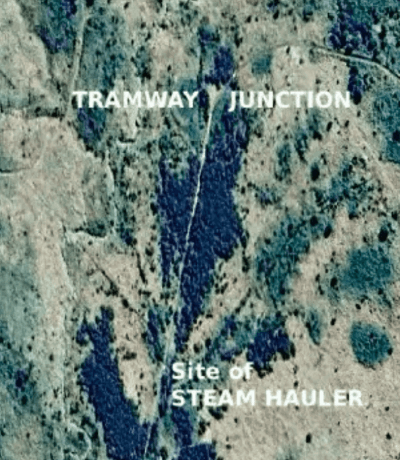
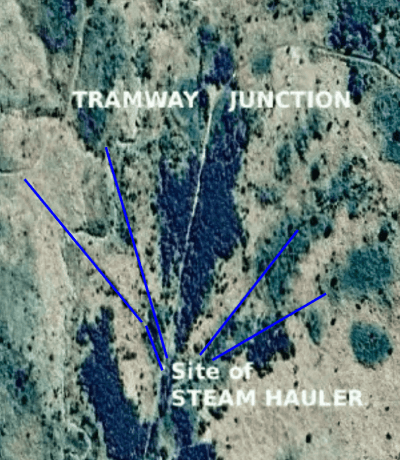
Drag-lines
Sites of the winches can be
determined from an aerial photo at the meeting points of long
straight water-filled ditches made where the logs were
dragged.
Steam Winches
Bennet and Punch used two big Judd steam winches to drag logs to the tramway. They were a New Zealand variant of the American-designed Lombard steam log hauler, and their steam engines were rated at about 100 horsepower.
The accompanying steam winch was designed to handle logs "of any size – within reason" at 140lb steam pressure.
The winch system used two horizontal cylinders (12in x 8in) with specific gear ratios for forward and return drums.
Bennet and Punch used two big Judd steam winches to drag logs to the tramway. They were a New Zealand variant of the American-designed Lombard steam log hauler, and their steam engines were rated at about 100 horsepower.
The accompanying steam winch was designed to handle logs "of any size – within reason" at 140lb steam pressure.
The winch system used two horizontal cylinders (12in x 8in) with specific gear ratios for forward and return drums.
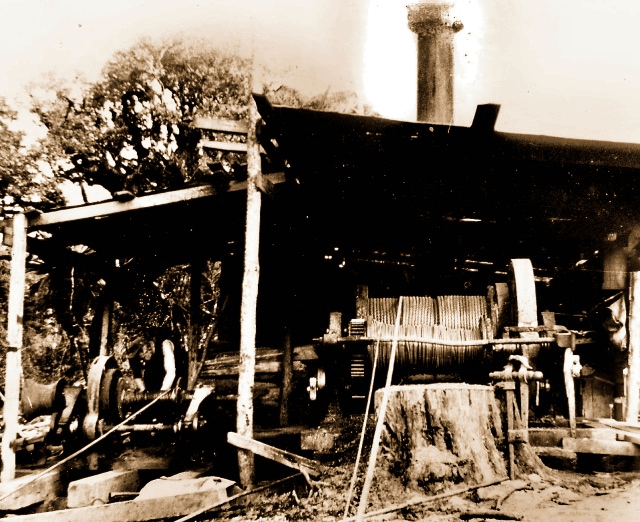
A draft horse was used to drag the lightweight wire-rope out to the first log.
It was put around a pulley,
hauled back to the winch again and attached to the end of
the heavy wire rope.
The steam-hauler then pulled
the heavyweight rope out to the log by winding in the light
rope.
The small winch on the left rolled logs onto the tram bogies.
The small winch on the left rolled logs onto the tram bogies.
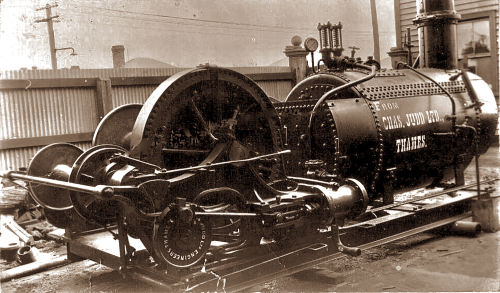
A boiler heated by tree branches provided steam pressure to move a piston back and forth very quickly and spin a wheel which turned a series of cogwheels.
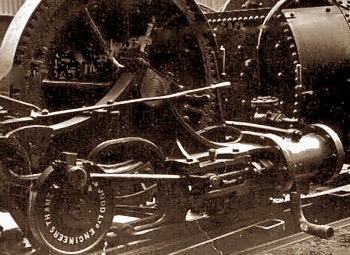
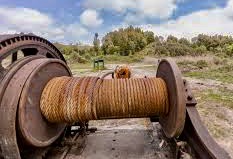
The gears turned the main winch very slowly, winding in a wire rope with great force.
The steam winches were built by Judd Engineering at Thames.
KIDS
Can you find any of the old skid lines marked in blue here?
Can you find any of the old skid lines marked in blue here?
S.T.E.M. Enthusiasts.
Can
you calculate the weight of a typical log this winch hauled?
How much force had to be applied by the hauler on its wire rope to move it?
There is a Judd hauler at the Putaruru Timber Museum.
How much force had to be applied by the hauler on its wire rope to move it?
There is a Judd hauler at the Putaruru Timber Museum.
Could
you build a working model of it?
MORE for you to read later
MORE for you to read later

Draft
webpage built by John Archer, 6 Jan 2026