 TE WAONUI O TANE |
|
| TRAMWAY
JUNCTION |
|
Bikes turn eastwards here, but can you find the old tramway track to the north?
I circled around the manuka thicket at the junction and walked up the northwest branch of the tramway, then back down the road on the far side of the stream.
At
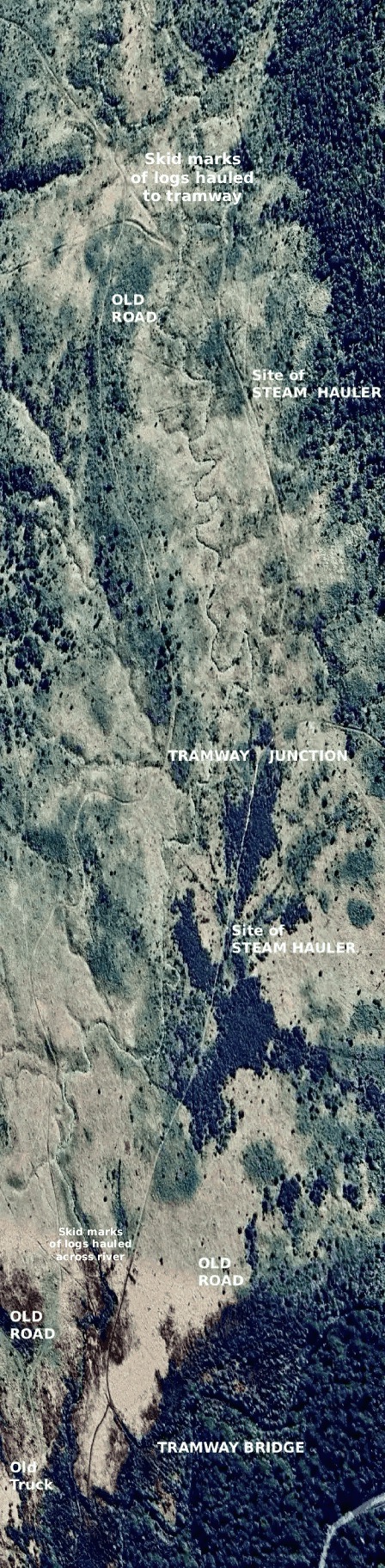
the end of the tramway, I found long straight ditches where a Judd
steam-winch had dragged logs down from the hillsides.
Deer hunters still use this road, keeping the grass down low enough for experienced e-bikers to ride on it.
More drag-lines come together 300m south of here.
Deer hunters still use this road, keeping the grass down low enough for experienced e-bikers to ride on it.
More drag-lines come together 300m south of here.
Drag-lines
The sites of the winches can
spotted in aerial photos at the meeting points of long
straight water-filled ditches made by the logs.
Bennett and Punch
In 1933 Alec Bennett and John Punch established a sawmill at Dreadnought Road, between Rangataua and Ohakune. From here they put in a tramline 8 kilometres up the lower slopes of Mount Ruapehu. They cut and milled timber until they ran out of logs in 1959.
KIDS
Can you find any of the old skid lines at the end of the northern tramway?
In 1933 Alec Bennett and John Punch established a sawmill at Dreadnought Road, between Rangataua and Ohakune. From here they put in a tramline 8 kilometres up the lower slopes of Mount Ruapehu. They cut and milled timber until they ran out of logs in 1959.
KIDS
Can you find any of the old skid lines at the end of the northern tramway?
TEENAGERS
Note
that there is a fire-prone grass monoculture on these flats,
with the pioneering forest species, manuka, making little
progress in re-establishing the former rainforest.
The rainforest on these denuded flats was a complex ecosystem, and its complexity made it very stable. It stored fertilizing minerals brought from the sea by nesting seabirds, plus vast quantities of carbon drawn from the atmosphere as CO2. Its multiple layers of humus, rotting branches, liverworts, mosses, ferns, shrubs, leafy trees and canopy trees could could store enough water for many weeks, minimising the danger of forest fire. The forest still on the slopes prevents soil (and nutrients) from being washed away in a deluge.
MAORI HERITAGE
Trees in the forest are seen as Tāne-mahuta, strong men rising to separate earth and sky. Tāne, the tree, holds the sky aloft, bringing light and life into the world. The widespread felling of Aotearoa's forests by Pakeha in the 19th and 20th centuries was calamitous to the world view of tribes who lived in the forest.
The full force of the sun and winds destroyed so many of plants and animals they relied on, and the their living world returned to dark times.
The felling of forests went against traditional models of behaviour. The verb ‘tika’ means erect, upright and correct – as a tree is upright and erect. It is behind the concept of tikanga (tika-nga), or correct behaviour. This arises from within a person, as a tree rises from the ground.
PO-NGA RA.
Humans are now destroying more than 30,000 hectares of forest every day: about 100 million hectares in the past decade. Very dark times indeed are coming.
The rainforest on these denuded flats was a complex ecosystem, and its complexity made it very stable. It stored fertilizing minerals brought from the sea by nesting seabirds, plus vast quantities of carbon drawn from the atmosphere as CO2. Its multiple layers of humus, rotting branches, liverworts, mosses, ferns, shrubs, leafy trees and canopy trees could could store enough water for many weeks, minimising the danger of forest fire. The forest still on the slopes prevents soil (and nutrients) from being washed away in a deluge.
MAORI HERITAGE
Trees in the forest are seen as Tāne-mahuta, strong men rising to separate earth and sky. Tāne, the tree, holds the sky aloft, bringing light and life into the world. The widespread felling of Aotearoa's forests by Pakeha in the 19th and 20th centuries was calamitous to the world view of tribes who lived in the forest.
The full force of the sun and winds destroyed so many of plants and animals they relied on, and the their living world returned to dark times.
The felling of forests went against traditional models of behaviour. The verb ‘tika’ means erect, upright and correct – as a tree is upright and erect. It is behind the concept of tikanga (tika-nga), or correct behaviour. This arises from within a person, as a tree rises from the ground.
PO-NGA RA.
Humans are now destroying more than 30,000 hectares of forest every day: about 100 million hectares in the past decade. Very dark times indeed are coming.
Draft
webpage built by John Archer, 26 Dec 2025
Copy and print this QR sign for your own forest or class project.

Copy and print this QR sign for your own forest or class project.